
The Hidden Cost of RFI Cycles: How Drawing Coordination Shapes Project Outcomes
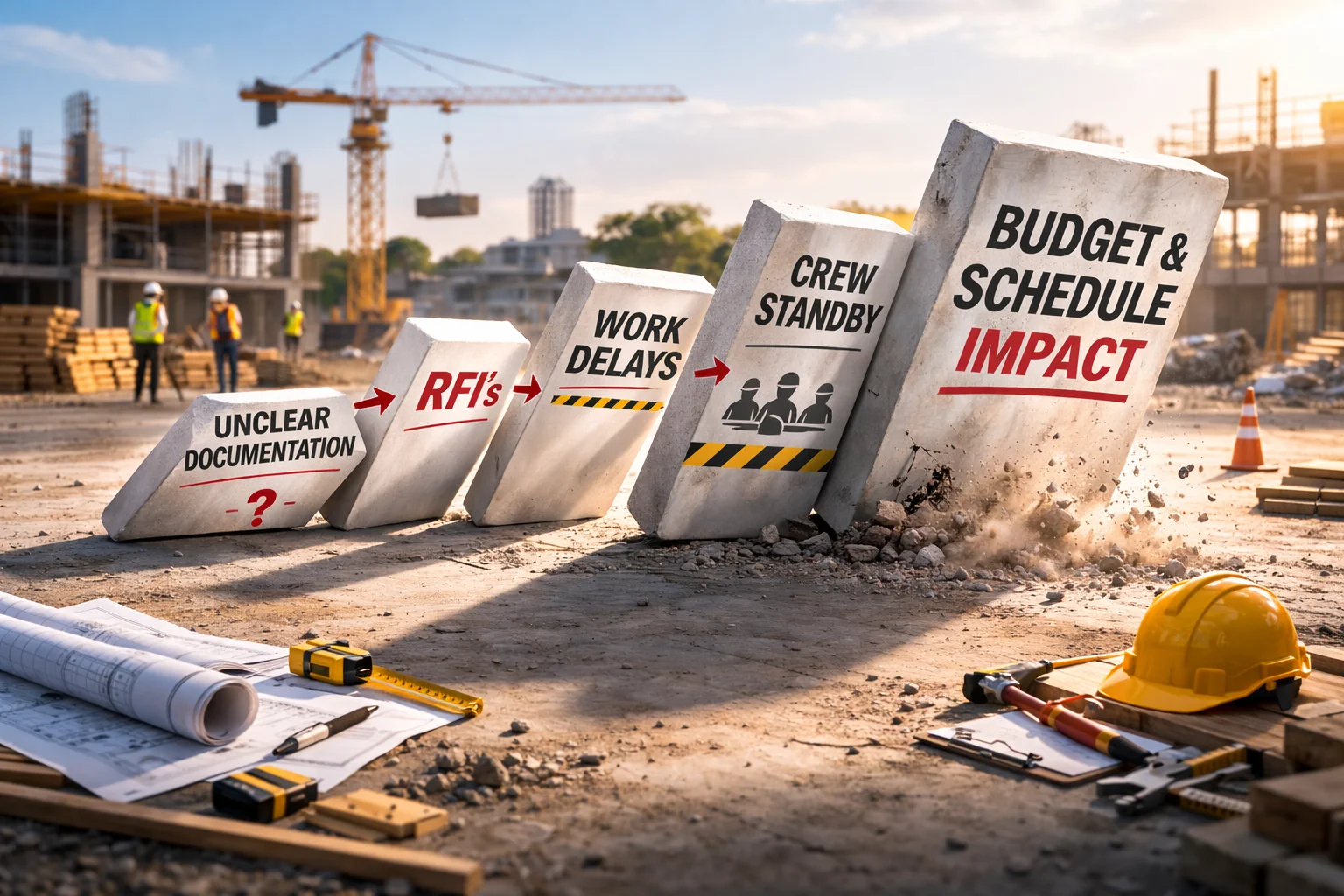
In construction, a Request for Information (RFI) is a formal question submitted by a contractor when drawings or specifications are unclear or open to interpretation. After a project is permitted and the contractor begins planning work, they review the drawings in detail, identify drawing coordination errors or construction documentation issues, and send RFIs to the design team asking for clarification. What starts as a single RFI can evolve into cycles of questions that influence schedules and change orders.
When RFIs Stop Being Isolated Events
Requests for Information are a standard part of construction. Most project teams expect RFIs to arise once work begins, and many view them as a practical way to clarify details that could not be fully resolved during design. Individual RFIs often seem minor and are addressed quickly within the project's rhythm.
What remains less visible is how RFI cycles accumulate. When similar questions recur across trades or phases, they begin to influence sequencing, cost, and decision-making. Over time, these RFI cycles reshape how a project unfolds, often in ways not immediately attributed back to documentation gaps.
Understanding the hidden cost of RFIs requires looking beyond individual questions and examining how coordination gaps in your drawing set propagate once construction begins.
How Drawing Inconsistencies Become Formal Questions
Many RFIs originate from subtle inconsistencies in construction documents. A wall type may not align with a fire-resistance rating shown elsewhere. A reflected ceiling plan may introduce conflicts with mechanical or lighting layouts. Door hardware selections may not fully align with egress or accessibility requirements indicated on life safety plans.
During design, these inconsistencies can remain dormant. Each drawing may appear reasonable when reviewed individually. Once construction starts, however, trades must reconcile information across sheets to execute the work. When your drawings do not clearly resolve these relationships, RFIs become the formal path for clarification.
In this way, RFIs are not interruptions. They are a direct response to uncertainty embedded in the documents.
Why RFI Cycles Tend to Multiply
RFIs rarely exist in isolation. Resolving one question often exposes additional dependencies. Clarifying a wall rating may require revisiting door schedules, hardware sets, and associated details. Adjusting one element can create new questions elsewhere, particularly in tightly coordinated systems like building systems and mechanical layouts.
As these questions accumulate, they influence sequencing decisions. Contractors may pause work in affected areas, reassign crews, or proceed with provisional assumptions. Each adjustment carries schedule and cost implications, even if no single RFI appears significant on its own.
Because these impacts are distributed over time and across multiple parties, the cumulative cost of RFI cycles is easy to underestimate until it becomes embedded in the project.
What Research Shows About Documentation and RFIs
Research into construction delays and change orders consistently points to documentation quality as a key factor in project performance. The FASA study on construction industry performance demonstrates that coordination gaps in construction documents are a leading contributor to RFIs, schedule delays, and cost escalation. This research links unresolved design-phase coordination issues directly to downstream construction impacts, establishing a clear relationship between drawing clarity and project outcomes.
Importantly, the FASA findings reveal that many RFIs stem from issues present in the drawings before construction began. These are not edge cases or unforeseeable conditions. They are coordination questions that become unavoidable once construction teams must act on the documents.
This pattern identified in the FASA research is frequently referenced in discussions about documentation quality and constructability across the construction industry, where recurring relationships between early coordination and downstream performance are examined per project type. The data underscores why addressing coordination during design, rather than waiting for RFIs during construction, directly reduces project delays and change orders.
Why Coordination Issues Surface During Construction
Coordination gaps tend to surface during construction because that is when drawings transition from conceptual references to instructions that must be executed. Construction forces specificity. Ambiguities manageable during design become obstacles when work must proceed.
Internal reviews during design often focus on confirming design intent, compliance, and completeness within individual drawings or disciplines. Construction, by contrast, demands alignment across all related information. The transition from design intent to execution is where unresolved relationships between sheets become visible.
This is not a matter of diligence or expertise. It reflects how and when coordination demands become unavoidable within the project lifecycle.
RFIs as Delayed Feedback on Documentation Clarity
Rather than viewing RFIs as disruptions, understand them as delayed feedback on drawing clarity. Each RFI identifies a location where intent was not fully communicated or where multiple interpretations were possible.
When you review RFIs collectively, patterns often emerge. Certain types of details, interfaces, or building systems generate questions repeatedly. These patterns point directly back to specific coordination challenges within your construction documents.
Recognizing RFIs as feedback shifts attention from managing them reactively to addressing how similar issues might be resolved earlier, before they carry construction-phase consequences.
How to Reduce RFI Cycles Before Construction Begins
RFI cycles can be substantially reduced through proactive coordination during the design phase. Three key approaches help catch coordination gaps before they reach the field:
BIM Clash Detection and Model Coordination
Building Information Modeling allows you to identify conflicts between building systems before drawings are finalized. Clash detection surfaces coordination issues that would otherwise appear as RFIs during construction. By resolving these conflicts during design, you reduce the number of RFIs per project and avoid costly rework downstream.
Structured Drawing Review and QA/QC Processes
Implementing a formal drawing review process that prioritizes coordination across disciplines catches inconsistencies early. AI assistance tools and automated QA/QC platforms can flag potential conflicts between sheets, highlighting areas where construction teams might later submit RFIs. This approach helps you clarify ambiguities and ensure plans and specifications align before drawings reach contractors.
RFI Management Platforms and Workflow Automation
While reducing RFIs before construction is the goal, effective RFI management during construction matters equally. Management platforms that centralize RFI tracking, automate workflow, and provide a single source of truth for project information help you resolve questions faster, reducing schedule delays and change orders. These systems make it easier to track RFIs, identify patterns, and maintain critical information flow across all construction professionals involved.
Implications for Practice
RFIs will always be part of construction, but their frequency and impact are not fixed. When your construction documents clearly align across plans, details, and disciplines, fewer questions arise in the field, and those that do are resolved more efficiently.
As projects grow in complexity, the cost of unresolved coordination escalates. Understanding how RFI cycles develop and why they persist highlights the importance of addressing documentation alignment early during design and before construction turns small gaps into compounding delays and costs.
By implementing proactive coordination strategies, structured drawing review, and management platforms throughout the project, you reduce the number of RFIs per project, maintain clearer communication across construction teams, and keep projects on track. The investment in coordination upfront delivers measurable returns in schedule stability and project budget control.
The data sources and research referenced in this article are part of a broader collection of permit review, delay cost, and construction compliance research we have compiled from government reports, industry associations, and consulting studies. Explore all data sources on our Insights page.
The Archidian team builds AI-powered tools to automate building code and life safety reviews for architects and design professionals.
Continue Reading
What Architects Actually Miss During Final QA/QC Reviews
Why coordination issues persist late in documentation and how review structure shapes what gets caught.
Why Most Permit Comments Are Preventable (and Where They Come From)
How review structure, documentation drift, and coordination gaps shape plan review outcomes.