
What Architects Actually Miss During Final QA/QC Reviews
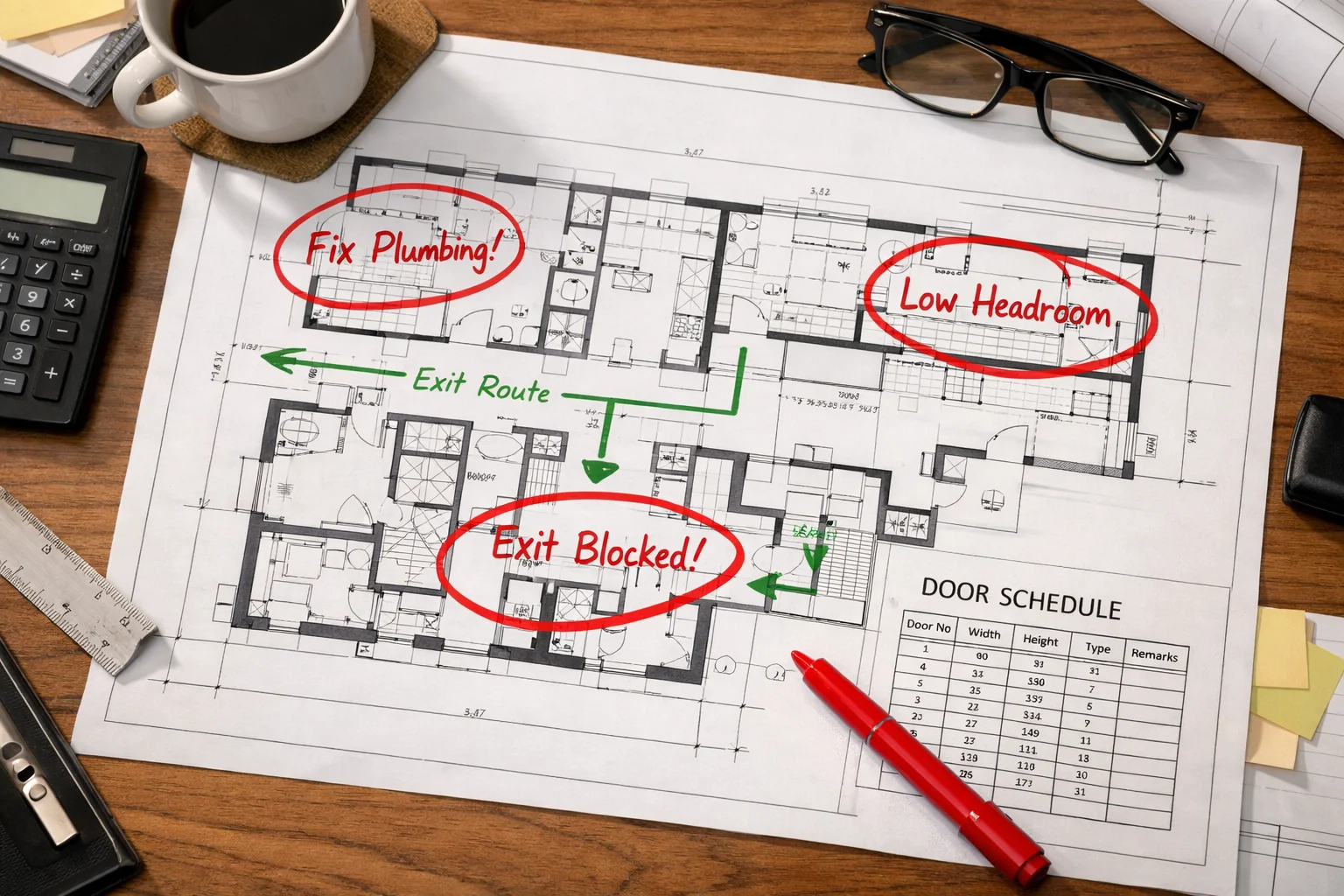
Final architectural quality control reviews are intended to serve as a safeguard, representing the final opportunity to identify coordination errors in construction documents, code conflicts, and discrepancy issues before drawing sheets are issued for permit or construction. In practice, however, this review process often becomes a confirmation exercise rather than a critical reassessment of the project. Certain categories of issues are consistently missed because of how construction workflows are typically executed under standard project constraints.
Familiarity Reduces Critical Distance
By the time a project reaches the final architectural QA/QC process, the design team has typically reviewed the drawing set numerous times. While this familiarity with each drawing and life safety diagram improves efficiency, it can also reduce critical distance. Reviewers may inadvertently confirm what they expect to see during a manual review rather than using ai to flag inconsistencies, particularly when compressed schedules necessitate a rapid turnaround in the workflow.
This effect is particularly prominent in life safety code compliance documentation. Occupancy classifications, egress strategies, and construction type assumptions are often established early in preconstruction and carried forward with limited reevaluation. When room uses change, suites expand, or circulation paths are modified late in the project, those foundational assumptions may no longer apply. While a construction drawing may appear coordinated on the surface, the underlying code assumptions supporting them may no longer align with the final construction documentation.
Code Is Rarely Evaluated as a System
Another recurring limitation of the final architectural quality control review process is that compliance issues are often verified in isolation rather than evaluated as a connected system. During a manual review, a reviewer may confirm that an egress width is compliant on a life safety drawing without a cross-check to verify that door swings, spec requirements, wall ratings, and clearances shown elsewhere fully support that condition. Fire resistance ratings may be correct in schedules but inconsistently represented on drawing sheets, creating a discrepancy.
When responsibilities are divided by discipline, coordination errors in construction documents can persist even in otherwise well-organized drawing sets. Each pdf may appear internally correct while still conflicting with related drawings, making these issues difficult to detect without a workflow that uses ai to automate the detection of logical errors and flag potential rework.
Experience Can Shape Expectations
Professional experience is one of an architect's greatest strengths, but during the quality control review process, it can also shape expectations. When construction projects resemble previous work, reviewers may rely on precedent rather than re-verifying requirements on every drawing against the current code cycle or local amendments. Subtle differences in jurisdictional interpretation, program use, or existing conditions can invalidate solutions that have worked successfully in the past, often leading to a discrepancy that results in costly rework.
Research from EVstudio found that a robust architectural QA/QC process, including peer review, can cut change orders related to errors and omissions by up to 75 to 80 percent. Deficiencies missed during a manual review frequently reappear during bidding or construction as expensive changes. A modern workflow that includes ai tools to automatically detect a discrepancy can help mitigate these recurring construction documentation gaps before the plan review stage.
What Commonly Slips Through Final QA/QC
Across various construction projects, consistent patterns of oversight tend to surface after the construction drawing set is finalized, often revealing construction documentation gaps.
- Occupant load assumptions may no longer align with final room uses
- Fire or smoke barriers often lose continuity when traced across drawing sheets, sections, and details
- Door ratings, swings, and hardware frequently conflict with the spec or accessibility requirements
- Accessibility clearances might appear compliant in isolation but fail when adjacent elements are factored in
- Life safety narratives may not reflect the building's final configuration
These are not merely drafting errors; they are coordination failures that only become apparent when the drawing is evaluated holistically using ai to flag a discrepancy rather than as a collection of individual sheets.
Understanding the Structural Limits of QA/QC
While it is tempting to view these oversights as a failure of the architectural QA/QC process itself, the issue is often more structural than procedural. Final reviews are frequently expected to evaluate vast amounts of interrelated data within narrow timeframes, often relying on a manual review that is error-prone. Comprehensively cross-checking information across a complex drawing set and multiple disciplines becomes increasingly difficult within these constrained windows, especially at the conclusion of the documentation phase. Recognizing these constraints does not diminish the value of professional judgment; instead, it highlights the need for a modern workflow and ai tools that can automate the detection of a discrepancy. By using ai to flag issues early, firms can reduce risk and avoid the rework that typically surfaces during bidding or plan review. These ai-powered systems help ensure that coordination errors in construction documents are caught before they impact the project schedule.
Rethinking the Role of Final QA/QC
The final architectural QA/QC process is most effective when treated as a focused review process rather than a catch-all opportunity to resolve every outstanding issue. Its primary value lies in challenging assumptions, reviewing high-risk conditions, and ensuring that life safety code compliance and code intent are communicated clearly and consistently throughout the drawing set.
When this clarity is achieved, plan review officials, general contractors, and inspectors are less likely to encounter construction documentation gaps, leading to fewer permit comments and downstream change orders. As construction projects increase in complexity and schedules tighten, rethinking how the manual review is supported by ai to flag issues becomes essential. This allows teams to strategically apply quality control throughout the workflow, reducing a discrepancy before it reaches the costly stages of plan review, bidding, or construction inspection.
The Archidian team builds AI-powered tools to automate building code and life safety reviews for architects and design professionals.
Continue Reading
5 Ways QA/QC Improves When Integrated with Bluebeam
How structured review outputs translate directly into markups, coordination, and team workflows.
Full Set Review vs Selective Sheet Review: When Each Makes Sense
How review scope shapes coordination clarity, permit feedback, and approval timelines.